
GA4 · Google Ads · Google Tag Manager
Google Consent Mode v2 Audit for UK Websites
Find out whether your visitor choices, Google consent signals and tracking behaviour agree. Get recorded evidence and a clear action list for your developer or marketing team.
Useful after a banner change, new Google tags or unexpected measurement behaviour.
£395 fixed fee · No VAT added · PDF report and 30-minute walkthrough included.
- Agree the scope
Confirm the site, consent setup, up to five URLs and one conversion journey.
- Test visitor choices
Compare consent signals, storage and requests across the agreed test states.
- Receive your PDF
Get recorded evidence, priorities, recommended actions and steps to retest.
- Review the findings
Use a 30-minute walkthrough to discuss the findings and next steps.
A defined scope, agreed before we start
Included in the £395 audit
- One website domain and one consent management platform.
- One web Google Tag Manager container, where used.
- Up to five agreed URLs and one conversion journey.
- GA4, Google Ads and GTM consent checks within that scope.
- Owner-authorised, read-only configuration review where needed.
Set up for a useful result
We agree the intended Basic or Advanced Consent Mode, browser, visitor location, pages and conversion test before starting. Configuration access is arranged through authorised invitations or a supervised walkthrough.
Additional domains, containers, regions, devices, server-side tagging or wider account audits require a separate scope. Please do not send passwords in your enquiry.
We test the choices visitors actually make
Fresh sessions separate independent test paths. Each record identifies the URL, date, browser, starting state and action, so the findings can be checked and repeated.
- Before any choiceCheck the initial consent state and activity before interaction.
- RejectCompare the recorded behaviour after optional categories are refused.
- AcceptCheck the consent updates and expected measurement activity.
- Choose categoriesTest separate analytics and advertising choices where available.
- Withdraw or changeReopen preferences and check the effect of a changed decision.
- Reload and navigateCheck whether the saved choice is reflected on subsequent pages.
From banner choice to Google-tag behaviour
Consent signals and timing
Review analytics_storage, ad_storage, ad_user_data and ad_personalization, including defaults, choice updates and category mapping.
Storage and requests
Compare cookies, browser storage and Google-related network activity across the agreed states. Review the selected GA4 and Ads journey and investigate signs of duplicate measurement.
Configuration where needed
Use authorised Tag Assistant and GTM checks to examine consent events, triggers and built-in or additional consent checks. Record whether evidence comes from the live site or a preview.
No cookies does not necessarily mean no data was sent. Basic Consent Mode blocks Google tags when consent is not granted. Advanced Consent Mode can send measurements without cookies while storage consent is denied. We interpret the evidence against the agreed implementation. Read Google’s explanation.
Evidence your team can act on
You receive a PDF findings report and a 30-minute walkthrough. Each issue connects the evidence to a practical next step and a way to verify the fix.
Download the four-page sample findings report (PDF). See the example evidence register, developer actions and retest criteria. The findings are fictional and demonstrate the format only.
Findings are labelled observed, unknown or not tested. We record limitations rather than treating missing evidence as a pass.
- A summary of the agreed scope and tested consent states.
- Dated screenshots, consent-state records and storage/network observations, with sensitive details redacted.
- Priorities for your developer, PPC team or agency.
- For each finding: observation, impact, recommended action and retest steps.
- Outstanding questions and any access or test limitations.
How this differs from our published website reviews. Our public reviews record visible controls, policies and public signals within their stated limits. This commissioned audit includes the agreed consent-state, storage and network tests. A published visual review should not be read as evidence that a full technical audit has been completed.
Genuine public observation · 27 September 2026
Worked example: Enoch Evans LLP
This example demonstrates the visible-controls stage of a review, using Enoch Evans’ public website. It is an independent observation, not a commissioned client audit or endorsement.
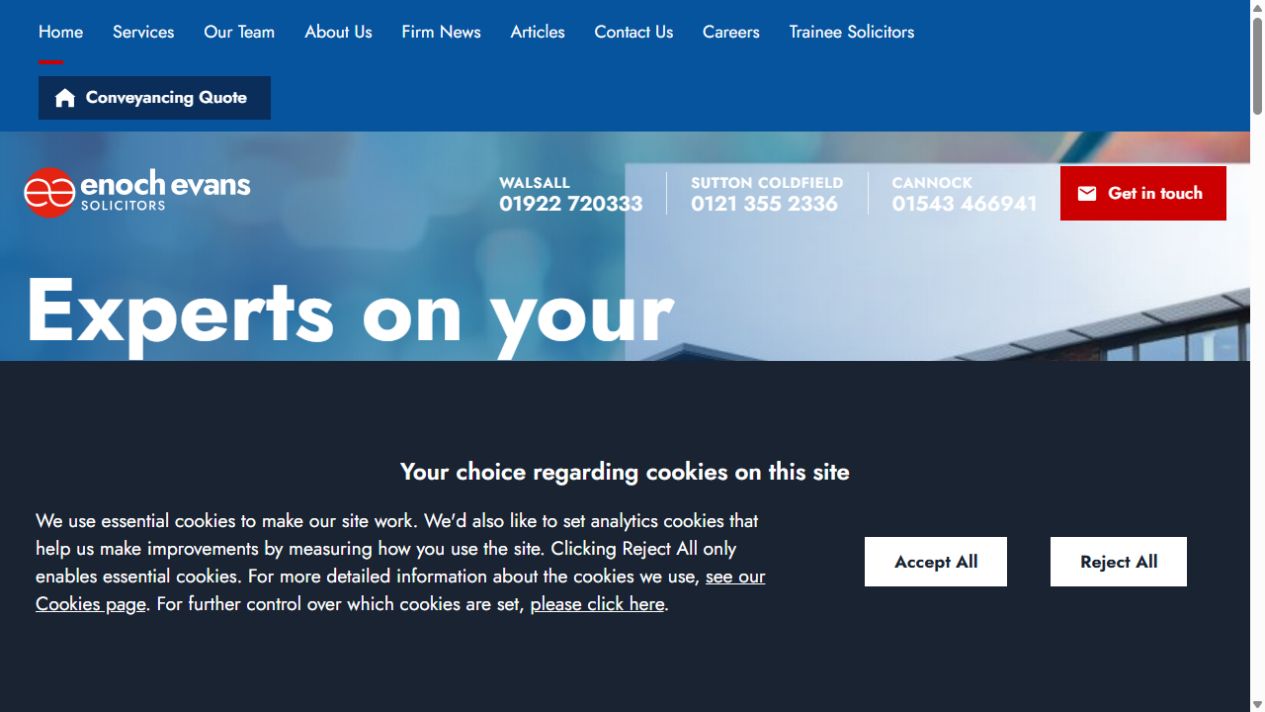
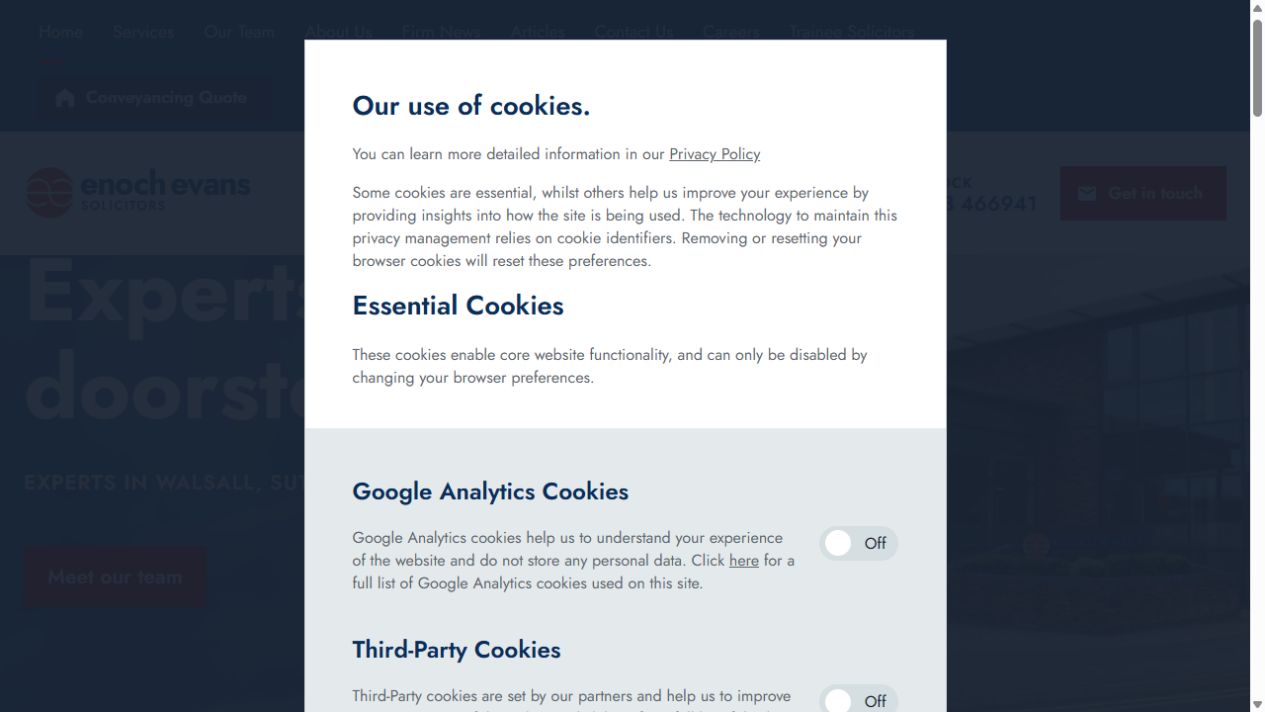
Observation → meaning → next test
- Action and result: We viewed the homepage notice, then opened its detailed controls. Accept All and Reject All were present; the panel displayed separate Google Analytics and third-party categories.
- What this establishes: The visitor has visible routes to accept, reject and inspect categories. A category label or an Off switch does not establish the actual Google consent state.
- What a commissioned audit would test next: Start fresh, independent sessions for reject, accept and category choices; compare the four Consent Mode signals, storage and network activity; then test withdrawal and reload. Report any mismatch with recorded evidence and reproducible retest steps.
This capture did not reset existing browser state or test storage, requests, consent signals or saved-choice persistence. It is not a complete Consent Mode audit and does not revalidate the June score. See the full published review and dated evidence update.
Basic and Advanced Consent Mode: what are you comparing?
Consent Mode adjusts Google-tag behaviour according to consent signals. A useful audit compares the intended implementation with recorded signals, storage and requests. It does not infer the implementation from the banner’s appearance.
| Question | Basic implementation | Advanced implementation |
|---|---|---|
| Before a choice | Google tags are blocked until the visitor interacts with the consent banner. | Google tags load with default consent states, usually denied until updated. |
| If consent is denied | Google’s basic implementation sends no data to Google. | Google tags can send cookieless pings while the relevant storage consent is denied. |
| What needs testing? | Tag blocking, the accepted-state updates and later changes to the choice. | Default timing, consent updates, the actual requests and the effect of category changes or withdrawal. |
This describes Google tags, not every script on a website. Technical behaviour does not establish that an implementation is legally suitable. See Google’s current Consent Mode overview.
Choose the review that answers your question
Use the homepage checker for source indicators, a policy review for wording and visible alignment questions, or the defined Consent Mode audit for the agreed Google-tag tests. The free checker cannot replace the technical audit.
Before you book
When will the report be ready?
Our target is five working days from the agreed start date, once the scope and required access are ready. We confirm availability and timing before booking and tell you if an access issue or untestable journey affects delivery.
Will you make changes to our website or accounts?
The £395 fee covers testing, analysis, the report and walkthrough. Implementation is a separate quote. Your developer or agency can use the findings to carry out the changes.
Does the audit certify compliance or guarantee better reporting?
No. The report describes the evidence from the agreed tests. It is not legal advice, formal compliance certification, Google approval or a guarantee of modelling eligibility, recovered conversions or advertising results.
Practical reading
Get a clear answer for your setup
Send your website URL, consent tool and main concern. We will confirm that your site fits the £395 scope and agree the start date.
£395 fixed fee · No VAT added · Implementation quoted separately